
How to Become a Pilates Instructor: 2026 Definitive Guide

The fitness industry doesn't reward generalists anymore. To lead the next generation of movement, you must specialize in high-intensity, results-driven training. Many aspiring teachers waste months on mat certifications that don't translate to the modern studio floor. Learning how to become a pilates instructor in 2026 requires a direct focus on the reformer. It's about structural integrity and athletic vigor. It's about performance.
You're right to feel overwhelmed by the choice between classical and contemporary paths. The fear of a saturated Los Angeles market is real. You need to know that your time investment will yield a high-performance career. This guide simplifies the journey. We deliver a clear five-step roadmap from dedicated practitioner to certified reformer specialist. You'll master the shift toward athletic styles and gain the confidence to dominate your first audition at a top-tier studio.
Key Takeaways
- Identify the critical shift from wellness-focused movement to high-performance athletic reformer specialization for 2026 careers.
- Master the precise steps on how to become a pilates instructor by focusing on anatomy mastery and machine-based coordination.
- Understand why bypassing generic mat and yoga training creates a competitive edge in elite fitness environments.
- Develop high-impact cueing skills and a professional personal brand to secure positions at top-tier Los Angeles studios.
- Learn to navigate the LA market by auditing studio cultures and preparing for high-intensity professional auditions.
The Professional Landscape of Pilates Instruction in 2026
The role of a Pilates instructor has undergone a radical transformation. We've moved beyond the era of simple fitness coaching into the territory of the movement specialist. In 2026, clients don't just want to move; they want to move with precision, power, and structural integrity. A modern instructor is an architect of the human body, focusing on biomechanics and high-performance outcomes rather than basic aerobic activity. When you research how to become a pilates instructor, you must decide if you want to be a generalist or a specialist. The market for generalists is shrinking while the demand for experts is surging.
There's a definitive shift from "wellness-focused" sessions to high-performance athletic reformer training. The modern practitioner values discipline and efficiency over soft, meditative routines. This evolution is driven by an urban audience that demands visible results and physical progress. They look for instructors who can manage the complexity of the reformer while maintaining a high-intensity environment. Success in this landscape requires a deep understanding of how the body handles resistance and load. You aren't just guiding a workout; you're leading a technical, high-energy session that prioritizes performance.
Why Specialization is the Key to Success
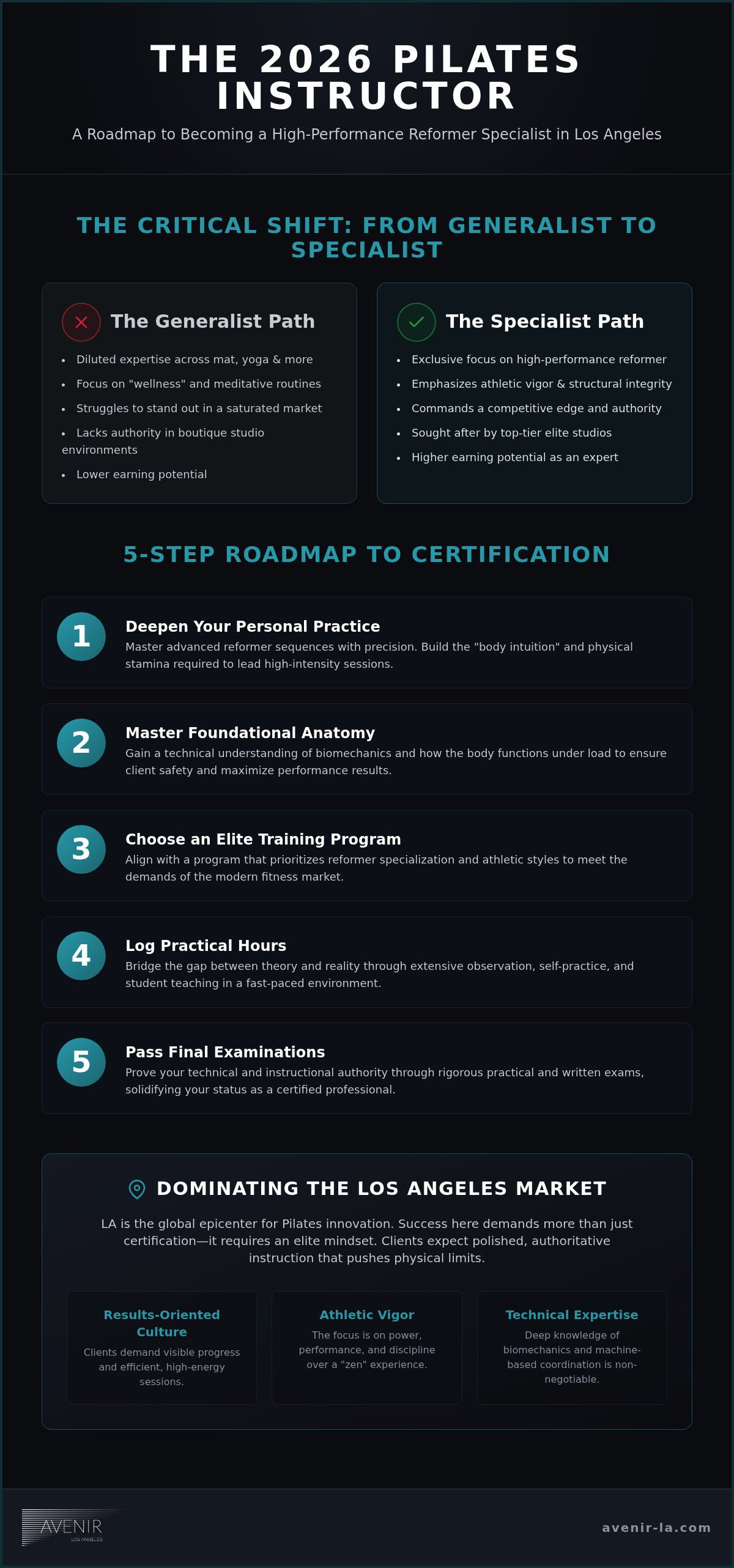
Generalist instructors are everywhere. They often dilute their expertise by trying to cover mat work, yoga, and various generic fitness modalities. This approach creates a "jack-of-all-trades" persona that lacks authority in the boutique studio market. To stand out, you must specialize. Boutique studios in 2026 are hunting for reformer-only specialists who possess elite technical skills. By focusing exclusively on the machine, you develop a level of expertise that generalists can't match. Embracing Athletic Reformer Pilates gives you a competitive edge. It positions you as a specialist in machine-based coordination, allowing you to command higher rates and secure positions at top-tier facilities.
Understanding the Los Angeles Market Dynamics
Los Angeles remains the global epicenter for Pilates innovation. In this city, the fitness culture is fast-paced and unapologetically results-oriented. The "athletic vigor" of the local scene means that clients expect a certain level of sophistication and discipline from their instructors. They aren't looking for a "zen" experience; they're looking for a professional who can push their physical limits. Understanding how to become a pilates instructor in LA requires an appreciation for this high standard. You must act as both a technical expert and a tastemaker. Your ability to deliver polished, authoritative instruction will determine your success in this competitive, elite environment.
Essential Steps to Earning Your Pilates Certification
The journey to professional certification is a rigorous physical and intellectual commitment. It demands more than just a passion for movement; it requires a disciplined approach to mastering the reformer. Understanding how to become a pilates instructor in 2026 starts with a shift in perspective. You aren't just learning exercises. You're learning to engineer movement. This process ensures you can handle the high-intensity demands of a modern studio while maintaining client safety and structural integrity.
- Step 1: Deepen Your Personal Practice. Before you can lead, you must master the movements. Building "body intuition" and physical stamina is essential for demonstrating advanced reformer sequences with precision.
- Step 2: Master Foundational Anatomy. You need a technical understanding of how the body functions under load. This isn't just about naming muscles; it's about understanding their role in athletic performance.
- Step 3: Choose Your Training Program. Align yourself with a program that mirrors your professional goals. If you want to excel in the Los Angeles market, prioritize elite reformer-based training.
- Step 4: Log Practical Hours. This includes observation, self-practice, and student teaching. These hours bridge the gap between theory and the reality of a fast-paced class environment.
- Step 5: Pass Final Examinations. The final stage of how to become a pilates instructor involves rigorous practical and written examinations to prove your technical and instructional authority.
Anatomy and Movement Principles
Structural integrity is non-negotiable in an athletic setting. You must understand functional anatomy to identify how muscles engage during complex, high-intensity reformer sequences. This knowledge allows you to adjust spring tension and alignment to prevent injury while maximizing results. Biomechanics is the application of mechanical principles to the human body to optimize movement efficiency and structural safety under spring-loaded resistance. Mastery of these principles allows you to give technical corrections that actually stick.
The Training Hours Breakdown
Your certification depends on a balance between classroom learning and practical application. Classroom hours provide the technical framework, but your real growth happens on the studio floor. Observation is critical. You must watch how elite instructors manage a room, handle equipment transitions, and maintain the energy of a group. Student teaching is the most vital phase of your development. It's where you find your voice and learn to deliver punchy, direct cues under pressure. If you're ready to start this high-performance journey, consider exploring a professional Pilates teacher training program that focuses on these core athletic standards.
Choosing Your Specialization: Classical vs. Athletic Reformer
Your choice of specialization defines your career trajectory. Classical Pilates often leans into a "Zen" approach, prioritizing the historical sequence and original mat repertoire. In contrast, Athletic Reformer training focuses on "Athletic Vigor" and machine-based resistance. When you analyze how to become a pilates instructor, you must decide which energy matches your professional brand. Traditional centers still value classical roots, but boutique studios in 2026 demand high-performance specialists who can push physical boundaries.
The reformer is the ultimate tool for the modern fitness era. It provides the precise resistance necessary for hypertrophy while challenging the body's deep structural stability. Unlike mat work, the reformer allows for measurable progress through adjustable spring tension. We exclude mat Pilates and yoga from our curriculum to maintain a high-intensity, athletic focus. This specialization allows you to master machine-based coordination without the distraction of unrelated modalities. It ensures every minute of training translates to the reformer-centric demand of elite studios.
The Athletic Reformer Methodology
This methodology centers on high-energy, high-intensity movements that demand total focus. It builds coordination and explosive power that traditional methods often overlook. This style appeals directly to athletes and cross-trainers in Los Angeles who value efficiency and visible results. You aren't just stretching; you're building a resilient, high-performance body. Instructors in this space act as performance coaches, driving clients through disciplined sequences that prioritize structural integrity. Explore the Avenir Teacher Training Path to master this specific, results-driven discipline.
Classical Pilates: A Historical Context
Classical Pilates originated with Joseph Pilates and his original 34 mat exercises. It's a foundational system that often emphasizes a slow, meditative pacing and strict adherence to historical form. While some instructors appreciate these roots, many find that classical training lacks the intensity modern clients crave. These professionals often choose to bridge from classical roots to athletic styles to stay relevant. The contrast in pacing is stark. Classical is meditative; Athletic is disciplined and fast-paced. As you learn how to become a pilates instructor, consider which environment will sustain your professional growth in a competitive market.
Practical Skills: From Anatomy Mastery to Client Retention
Mastering the technical mechanics of the reformer is only the beginning. To thrive in a high-intensity studio, you must master the room itself. Professional instruction in 2026 requires a blend of technical expertise and commanding presence. When you learn how to become a pilates instructor, you're also learning how to manage energy, expectations, and safety simultaneously. High-performance clients expect a seamless experience. They want an instructor who is both a movement expert and a disciplined leader. Your ability to retain clients depends on your capacity to deliver consistent, results-oriented sessions every time.
The Art of the Cue
High-intensity reformer sessions move fast. Descriptive cueing, which explains the theory behind a move, often slows the momentum. Use imperative cueing instead. Give direct, punchy commands that drive immediate action. Brevity ensures the heart rate stays up and the focus remains sharp. Tactile cueing is the application of precise, hands-on touch to guide a client's body into optimal alignment and ensure the correct muscle groups are engaged. This physical feedback is often more effective than verbal instruction in a loud, energized room. It shows you're paying attention to the details of their performance.
A single group class often contains a mix of elite athletes and newer practitioners. You must learn to layer your instructions. Offer advanced progressions for those seeking a challenge while maintaining clear, safe modifications for others. Never compromise on safety. Inspect your equipment daily. Check the spring tension and the integrity of the straps. A high-performance studio relies on high-performance machinery. If the equipment fails, your reputation follows. Consistent maintenance is a hallmark of a true professional.
Building Your Professional Brand
In the Los Angeles market, you are a tastemaker. Your personal brand is your portfolio. Use social media to showcase your movement expertise and technical knowledge rather than generic lifestyle content. Focus on structural integrity and physical results. Network with local fitness professionals to build a referral pipeline. Continuing education is also vital to staying ahead of movement trends. Staying ahead of the curve ensures you remain an authority in your field. Are you ready to refine your skills and lead the industry? Join our Pilates teacher training to master the professional standards of the modern industry.
Launching Your Career in the Los Angeles Fitness Market
Los Angeles is the global epicenter of fitness innovation. In this city, the ceiling for elite instructors is higher than anywhere else in the world. However, the competition is disciplined and fierce. Success requires more than just a certificate; it requires a strategic entry into the local market. Understanding how to become a pilates instructor in LA means recognizing that every studio has a distinct culture. You must find a professional environment that aligns with your high-performance standards and athletic vigor. Don't just apply to every open position. Audit the studios first.
Take classes at the top boutique facilities in West Hollywood, Santa Monica, and Venice. Observe the client demographic and the instruction style. Are they looking for a "zen" experience, or are they demanding structural integrity and visible results? In 2026, the most successful instructors are those who position themselves as specialists in athletic reformer techniques. Once you identify a studio that matches your persona, prepare for the audition. This is your opportunity to prove you can lead a room with authority and technical precision.
The Audition Process
The audition is a high-stakes performance of your movement expertise. Studio managers in LA aren't just looking for someone who knows the exercises. They're looking for energy, discipline, and modern professionalism. A common mistake new instructors make is being too descriptive or "soft" in their delivery. Avoid long explanations. Instead, demonstrate an athletic reformer flow that prioritizes seamless transitions and constant movement. Show that you can manage the equipment efficiently while delivering punchy, imperative cues. You must command the room from the first second. If you hesitate, you lose the audience. Focus on showing your ability to correct form quickly without breaking the momentum of the session.
Diversifying Your Income
The financial reality of being a top-tier instructor involves balancing multiple revenue streams. Group classes provide a consistent base and high visibility. They're your primary tool for building a following. However, private sessions offer the highest margin for your time. Use your expertise to attract high-net-worth clients who value personalized, results-driven training. In 2026, we're also seeing a massive growth in high-end Pilates retreats. These offer a secondary income stream while reinforcing your status as a lifestyle tastemaker. By specializing in the reformer, you ensure you're always in demand at the most exclusive facilities. Ready to lead the next generation of movement? Start your professional journey with Avenir Athletic Pilates and master the athletic specialist path.
Lead the Future of Movement
The fitness landscape in 2026 demands more than just enthusiasm; it requires a commitment to technical excellence. Success depends on your ability to deliver high-intensity, technical instruction that produces visible results. You've seen the roadmap. You understand that specializing in the reformer is the most direct path to a high-performance career. Mastering how to become a pilates instructor means moving beyond generic mat work to embrace a results-oriented movement philosophy. Generic training is no longer enough to command the attention of elite clients.
Position yourself at the top of the Los Angeles market with an elite athletic reformer curriculum. Expert mentorship is the bridge between earning a certificate and commanding a room with authority. True professionals focus on structural integrity and athletic vigor to stand out in a competitive market. It's time to transition from a dedicated practitioner to a certified specialist. The industry is waiting for leaders who can bridge the gap between technical expertise and modern performance standards.
Apply for Avenir Athletic Pilates Teacher Training to refine your craft and secure your future. Your professional evolution starts now. Build the career you want in the city that defines the industry.
Frequently Asked Questions
How long does it take to become a Pilates instructor in 2026?
Certification timelines vary depending on your chosen specialization. A dedicated reformer-focused program typically requires several months of intensive study and practical application. You'll log essential hours for observation, self-practice, and student teaching to build technical authority. In 2026, the industry prioritizes efficiency and technical mastery over prolonged, generic courses. Choosing a specialized path allows you to enter the professional market faster with the elite skills that boutique studios demand.
Do I need a dance or gymnastics background to teach Pilates?
You don't need a background in dance or gymnastics to succeed in the modern industry. Current instruction focuses on structural integrity and biomechanics rather than performance art. While body awareness is an advantage, it's a skill you build through disciplined practice on the reformer. Studio owners value instructors who understand movement science and can deliver high-intensity results. Your ability to cue effectively and maintain a professional presence is your greatest asset.
What is the difference between Mat and Reformer certification?
Mat certification focuses on floor-based exercises using body weight as the primary resistance. Reformer certification centers on machine-based coordination and spring-loaded resistance for hypertrophy and stability. In the 2026 fitness market, reformer specialists are in significantly higher demand. Boutique studios, particularly in Los Angeles, prioritize instructors who can manage complex machinery and deliver high-intensity sessions. Specializing in the reformer allows you to skip generic modalities and master a high-performance tool.
How much do Pilates instructors earn in Los Angeles?
Los Angeles offers a high ceiling for elite instructors who specialize in athletic reformer techniques. Income varies based on your ability to balance high-volume group classes with premium private sessions. Specialists often command higher rates at boutique facilities due to their technical expertise. Building a personal brand as a movement expert allows you to leverage your skills for high-end retreats and private coaching. The city's competitive nature rewards those who maintain a disciplined, professional standard.
Is the Pilates Method Alliance (PMA) certification necessary?
The PMA provides a national standard, but many top-tier studios prioritize specific methodology and practical skill over a general credential. When researching how to become a pilates instructor, focus on the quality of your training program's curriculum and mentorship. Boutique studios look for specialists who fit their specific athletic culture. While national recognition has value, your ability to demonstrate technical mastery during a live audition is the ultimate decider for your career success.
Can I get certified as a Pilates instructor online?
You can complete foundational anatomy and theory online, but physical mastery requires in-person training. Mastering the reformer demands hands-on experience with equipment safety and tactile cueing. High-performance studios rarely hire instructors who lack real-world practical hours on the machine. A hybrid approach allows for efficient learning while ensuring you develop the body intuition necessary to lead a professional session. In-person mentorship is non-negotiable for those seeking elite status in 2026.
What are the prerequisites for joining a teacher training program?
A consistent personal practice is the primary prerequisite for any reputable program. Most elite training tracks require a minimum number of reformer hours before you can enroll. This ensures you have the physical stamina and basic coordination to handle the rigorous curriculum. Understanding how to become a pilates instructor begins with your own discipline on the machine. You must be able to perform the movements with structural integrity before you can lead others.
How do I choose between Classical and Contemporary Pilates training?
Base your choice on your professional career goals and desired studio environment. Classical training adheres to original sequences and often emphasizes mat work and historical form. Contemporary or athletic training focuses on modern biomechanics and high-intensity reformer sequences. If you want to work in the fast-paced Los Angeles boutique scene, an athletic specialization is the better fit. It aligns with the demand for results-driven, disciplined movement that appeals to high-performance clients.